







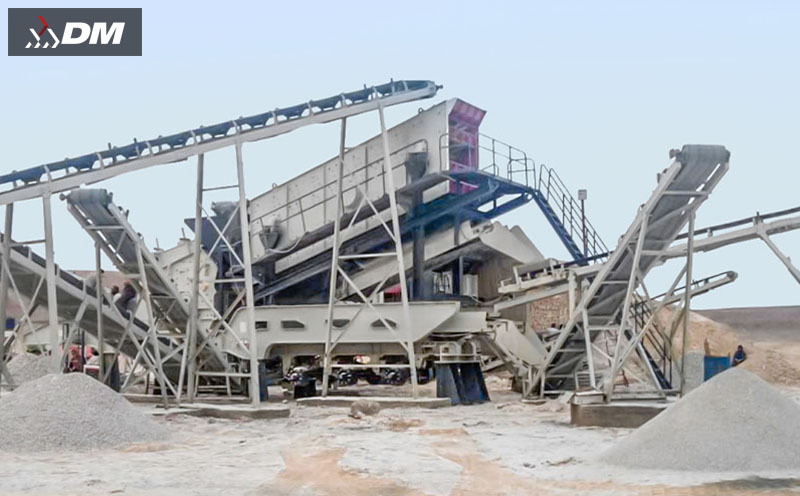
I. Australia's "EIA Threshold" for Crushing Operations: Dual Hard Constraints of Low Noise and Dust Control
As one of the countries with the strictest environmental standards globally, Australia's National Environment Protection Measures (NEPM) sets "zero-tolerance" red lines for crushing operations: Daytime noise limits near residential areas are ≤55 decibels and nighttime ≤45 decibels, with a maximum daily fine of AUD150,000 for violations; Dust emissions (PM10/PM2.5) must meet ≤5mg/m³, and real-time online monitoring and annual EPA (Environment Protection Authority) audits are mandatory; Some mining areas (such as the Pilbara region in Western Australia), adjacent to nature reserves, also need to meet additional "zero ecological disturbance" requirements, prohibiting operational dust from affecting endangered species habitats.
The "high noise and high dust" pain points of traditional crushing plants are prominent: A Queensland quarry was collectively complained by nearby residents due to excessive noise (measured 78 decibels) and was forced to suspend operations for 3 months for rectification; A infrastructure supporting crushing plant in Victoria was fined AUD80,000 by the EPA for excessive dust emissions, and its EIA renewal was blocked. The industry consensus has been formed: In Australia, "low-noise control" and "dust management" are the core prerequisites for crushing plants to pass EIA and operate legally, and are key to balancing production efficiency and ecological protection.
II. Breaking Through with Chinese Solutions: A Trinity Technical System of "Low Noise + Dust Removal + High Efficiency"
Targeting Australia's strict EIA standards and crushing operation needs, China's new crushing plant solution takes "ultra-low noise design, full-process dust control, and intelligent high-efficiency production" as the core, integrating localized adaptation technologies to achieve "one-time EIA approval, zero operational complaints, and stable production capacity". Its core advantages are reflected in three modules:
1. Multi-Dimensional Noise Reduction System: A "Silent Revolution" Breaking Through Noise Limits
The solution adopts a full-link noise reduction technology of "source noise reduction + process sound insulation + terminal muffling": The crushing main engine selects a low-speed and high-torque model, with a speed 30% lower than traditional equipment, reducing mechanical impact noise from the source to a base noise of 60 decibels; The main body of the equipment is equipped with "damping sound insulation panels + double-layer sound insulation covers", with the outer layer adopting a composite structure of sound-absorbing cotton and metal perforated panels, and the inner layer filled with flame-retardant sound insulation materials, improving the overall sound insulation effect by 40%; The feed inlet, discharge outlet and conveyor belt adopt flexible sealed connections, paired with silent idlers and shock-absorbing bases, further reducing operating noise to 52 decibels, far below Australia's nighttime limit for residential areas; Auxiliary equipment such as fans and motors are equipped with special mufflers, and the outlet noise is controlled within 48 decibels. In field tests at a project near residential areas in New South Wales, the factory boundary noise was 50 decibels during the day and 42 decibels at night, fully meeting NEPM standards.
2. Fully Enclosed Dust Control: Achieving "Zero Dust Emission" Operations
A closed-loop dust management system of "source blocking + process capture + terminal purification" is built: The crushing plant adopts a fully enclosed workshop design, with dust-proof panels installed on the top and surrounding areas of the workshop, only reserved for maintenance channels with sealed doors to prevent dust leakage; The feeding link is equipped with a negative pressure dust hood, which directly sucks the raised dust into the dust removal system through pipelines, with a capture efficiency of 99%; Key nodes such as the crushing chamber, screening machine and conveyor belt adopt a fully enclosed structure, and the conveyor belt is equipped with anti-overflow skirts and guide troughs to reduce secondary dust generated by material scattering; The terminal is equipped with a two-stage purification system of "bag dust removal + electrostatic dust removal", and the dust emission concentration after filtration is as low as 2.8mg/m³. It is also equipped with online monitoring equipment, and data is uploaded to the EPA supervision platform in real time to achieve traceability. The system has passed Australia's AS/NZS 3580.10.1:2003 dust emission standard certification.
3. Intelligent High-Efficiency Production: Dual Benefits of Production Capacity and Energy Saving
The solution is equipped with an industrial internet platform and intelligent control system to achieve efficient and low-consumption operation: AI algorithms real-time match ore hardness and crushing parameters, automatically adjust feeding speed and crushing pressure, avoiding "no-load high consumption" or "overload shutdown". Production efficiency is 25% higher than traditional factories, with a daily processing capacity of 1,500 tons per plant, meeting the aggregate needs of large Australian infrastructure projects; It adopts a "hybrid diesel-electric dual-power" design, using electric drive in grid-covered areas to reduce energy costs by 50%, and when switching to diesel drive in remote mining areas, the intelligent fuel-saving system can reduce fuel consumption by 18%; It is equipped with a modular design, which can be quickly assembled or disassembled according to project needs, shortening the construction cycle to 3 months, 40% shorter than traditional factories. In the application at a mining area in the Pilbara region of Western Australia, the solution achieved 365 consecutive days of trouble-free operation, and the comprehensive energy consumption was 32% lower than that of local similar factories.
4. Localized Adaptation Upgrade: Meeting Australian Scene Needs
Strengthened adaptation to Australia's climate and ecological characteristics: The workshop adopts weathering steel and anti-corrosion coatings, adapting to the dry and hot environment in South Australia and the high salt spray environment along the coast of Western Australia, reducing equipment corrosion rate by 95%; For projects near nature reserves, additional "dust settlement monitors" and "ecological early warning systems" are installed. Once the dust concentration approaches the threshold or wildlife activities are detected, it automatically reduces production load and starts sprinkler dust reduction; It is equipped with Australian standard safety protection devices and operation interfaces, supporting English operation and remote operation and maintenance, and the response time of local technical teams is shortened to 8 hours.
III. Practical Verification: A Model of "EIA Pass" for Australian Projects
In 2023, China's new crushing plant solution was implemented in two typical Australian projects, both achieving one-time EIA approval and efficient operation:
- Melbourne Urban Infrastructure Supporting Crushing Plant: Located within 3 kilometers of residential areas, it adopts a fully enclosed silent design with daytime noise of 51 decibels and nighttime noise of 43 decibels, and dust emission of 3mg/m³. It successfully passed the EIA of the Victorian EPA, supplying 1,200 tons of aggregates daily, helping the urban road upgrade project complete 6 months ahead of schedule;
- A Gold Mine Supporting Crushing Plant in Western Australia: Adjacent to the Pilbara Nature Reserve, the solution is equipped with an ecological early warning system and an advanced dust removal module, with dust emission as low as 2.5mg/m³, no impact on the surrounding ecology, and won the EPA "Green Operation Certification". It processes 500,000 tons of ore annually, increasing gold mine separation efficiency by 15%.
The project director of an Australian infrastructure enterprise commented: "Australia's EIA requirements for noise and dust are almost harsh. China's solution not only passed the audit at one time but also achieved high-efficiency production, breaking our perception that 'environmental protection and efficiency cannot be achieved simultaneously'."
IV. Australian Scene Adaptation and Operation Guide
Combined with the EIA requirements and operation scenarios of different regions in Australia, the solution can achieve precise adaptation:
1. Scene-Specific Solution Configuration
- Near urban areas/residential areas: Fully enclosed silent crushing plant + two-stage dust removal system + nighttime noise reduction mode, strictly controlling noise and dust diffusion;
- Remote mining areas (non-ecologically sensitive areas): Modular mobile crushing plant + hybrid diesel-electric power + basic dust removal module, balancing efficiency and cost;
- Ecologically sensitive areas (near nature reserves): Enhanced dust control + ecological early warning system + low-load operation mode, meeting "zero disturbance" requirements.
2. Localized Operation Tips
- Pre-EIA Preparation: Connect with the local EPA in advance, provide equipment noise and dust emission test reports, and formulate targeted environmental protection plans based on the project location;
- Daily Operation and Maintenance Management: Clean dust removal filter bags and sound insulation covers daily, calibrate online monitoring equipment weekly, and conduct self-inspection of noise and dust emissions monthly;
- Emergency Response Mechanism: Establish an EPA compliance early warning system. Once parameters are abnormal, automatically start emergency measures such as load reduction and enhanced dust removal to avoid violations.
Conclusion
Australia's strict EIA standards are both the "access threshold" for crushing operations and the "catalyst" for the green transformation of the industry. China's new crushing plant solution solves the problems of noise and dust with independent innovative technologies, meets production capacity needs with intelligent and efficient production, and adapts to Australian scenarios through localization, achieving the triple goals of "environmental compliance, efficient operation, and ecological friendliness". From Melbourne's urban infrastructure to Western Australia's remote mining areas, this solution is injecting green momentum into Australia's crushing industry with the integrated advantage of "Chinese technology + Australian standards", and writing a practical model for China-Australia equipment and technology cooperation. Choosing China's crushing plant solution that has passed Australia's strict EIA means seizing market opportunities under compliance requirements and injecting long-term value into sustainable development.
If you would like to get help immediately, you can also fill your requirements on the following form, we will contact you on the right time.


Get In Touch