







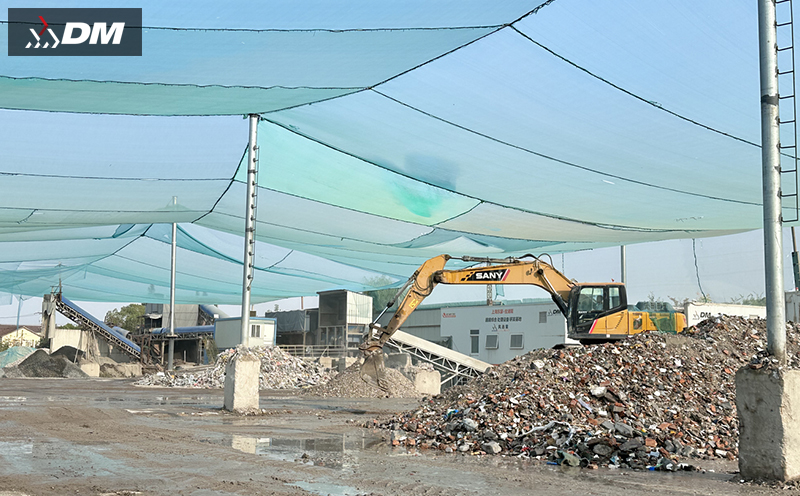
Australia generates over 32 million tons of construction waste annually, with only 45% recycled and the rest landfilled, causing land occupation and environmental pollution. To meet net-zero emission goals and the Green Star rating system, traditional disposal methods need innovation. This integrated solution transforms construction waste into resources through technological integration, offering an efficient and compliant green path for the infrastructure industry.
1. Compliance Requirements Under the Green Star System
Australia's Green Star system mandates an 80% recycling rate for new projects and 90% for demolition projects. The integrated solution boosts resource utilization to over 95% via intelligent sorting and recycling, helping projects achieve high ratings and reduce compliance costs. For example, a Melbourne commercial complex project upgraded from 4-star to 5-star and secured government subsidies.
2. Core Technology Integration
1. Intelligent Pretreatment System
Integrates AI visual recognition, electromagnetic induction, and density sensing for precise separation of steel, concrete, and plastic, with 99.8% accuracy. In a Perth industrial demolition project, the system processed 800 tons/day, 60x more efficient than manual sorting.
2. Graded Recycling Technology
Produces C80-grade recycled aggregates via three-stage crushing, particle shaping, and surface activation for high-speed rail and skyscrapers. Masonry powder is used for permeable bricks and precast components, supporting sponge city development. In a Sydney bridge demolition, 50,000 tons of waste yielded 32,000 tons of aggregates and 150 million bricks, saving 180 million AUD in mining costs.
3. Full-Process Environmental Control
Uses sealed corridors, pulse bag filters (≥99.99% efficiency), and fog cannons to keep dust below 2mg/m³; double-layer sound insulation and damping bases reduce noise to ≤60dB(A); wastewater is 100% recycled, achieving zero landfilling.
3. Implementation Path
- Policy Compliance: Built-in Green Star scoring system generates reports, connects to regulatory platforms, and supports applications for the federal Circular Economy Innovation Fund.
- Equipment Adaptation: Compact mobile units (urban), tracked crushers (remote mines), and intelligent production lines (large plants) meet diverse needs.
- Industrial Collaboration: Digital platform links generators, processors, and users; quality tracing system enhances market acceptance. A Brisbane cluster processes 800,000 tons/year, creating 1,200 jobs.
4. Case Study: Melbourne CBD Regeneration
The project processed 120,000 tons of waste using 2 compact mobile crushers and intelligent sorting, operating at night for transport and day for processing. Results: 98.5% resource utilization, producing 92,000 tons of aggregates and 28 million bricks; reduced land use by 10 hectares and carbon emissions by 23,000 tons; secured 4.2 million AUD subsidies with an 18-month payback period.
5. Future Outlook
Future focus: ① Developing electric and hydrogen-powered equipment for zero emissions; ② AI optimization of recycling processes to boost value; ③ Expanding recycled aggregate applications in 3D printing and road materials to build a complete circular chain.
If you would like to get help immediately, you can also fill your requirements on the following form, we will contact you on the right time.


Get In Touch