







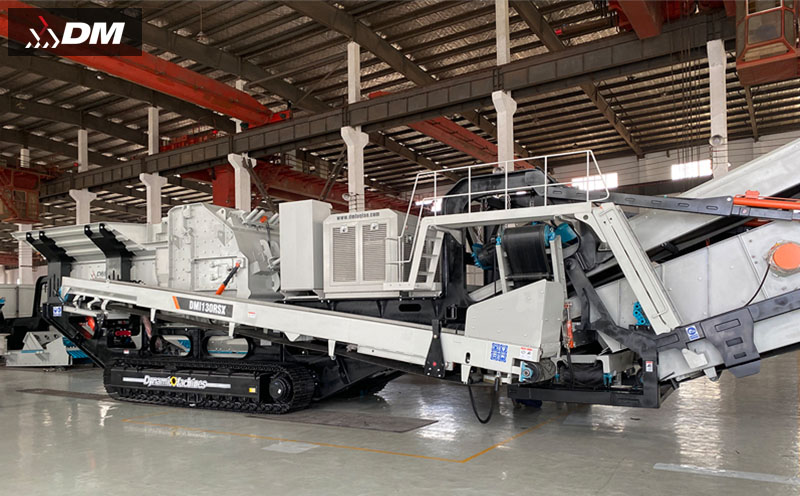
In the global mining and infrastructure sectors, operations in challenging sites (such as remote mining areas, steep slopes, urban demolition sites, and environmentally sensitive zones) place extremely high demands on crushing equipment. Traditional fixed crushing systems face problems such as difficult transportation, long deployment cycles, and high dependence on site conditions, while ordinary mobile equipment has limitations including insufficient power, low automation levels, and the need for extensive manual intervention. The emergence of autonomous mobile crushing plants, with core advantages of "fully independent operation, intelligent autonomous control, all-terrain adaptability, and efficient environmental protection operations," has completely changed the mode of crushing operations in complex sites. They have become ideal solutions for scenarios such as mining, urban renewal, and emergency rescue, providing users worldwide with unprecedented operational flexibility and efficiency.
Core Advantages: Four Key Features Reshaping Crushing Operations in Complex Sites
Autonomous mobile crushing plants are integrated equipment that combines crushing, screening, conveying, power supply, intelligent control, and other functions. Their core advantages are reflected in the following four dimensions:
1. Fully Independent Operation, Free from External Dependencies
Autonomous mobile crushing plants have complete self-support capabilities and do not rely on external infrastructure: ① Independent power system: Equipped with a high-power diesel generator (optional new energy hybrid power), it can meet the power needs of all system equipment such as crushing, screening, and conveying, with continuous operation time exceeding 24 hours; ② Self-sufficient material processing: Integrates jaw crusher, cone crusher/impact crusher, vibrating screen, belt conveyor, and other complete equipment, realizing one-stop processing from raw material crushing to finished product classification; ③ Intelligent material management: Equipped with level sensors and automatic feeding systems, it can automatically adjust the feeding speed according to the amount of material in the crushing chamber to avoid overload or underload operation. In a remote gold mine project in Western Australia, an autonomous mobile crushing plant operated continuously for 72 hours without external power and unattended, processing 2,500 tons of ore and producing three specifications of qualified aggregates, significantly reducing on-site operation costs.
2. Intelligent Autonomous Control, Enabling Unmanned Operation
Integrating advanced automation and remote control technologies, autonomous mobile crushing plants can achieve highly intelligent operations: ① Autonomous navigation and positioning: Using GPS/Beidou positioning system and lidar obstacle avoidance technology, the equipment can automatically drive to the operation site according to the preset route, with an accurate positioning error of no more than 5 centimeters; ② Remote monitoring and operation: Through an industrial internet platform, operators can real-time monitor equipment operation status (such as crushing chamber temperature, bearing vibration, oil quality, etc.) in a control center thousands of miles away, and can remotely adjust crushing parameters and start/stop equipment; ③ Fault self-diagnosis and early warning: The system has a built-in AI fault diagnosis module, which can automatically identify potential faults (such as liner wear, lubricating oil leakage, etc.) by analyzing equipment operation data and issue early warnings in advance, reducing equipment failure rates. In steep slope operations at a copper mine in Chile, autonomous mobile crushing plants实现了unmanned crushing operations through remote control, not only improving operational safety but also reducing the number of operators by 60%.
3. All-Terrain Adaptability, Conquering Complex Environments
Designed to fully consider terrain adaptability for the harsh environments of complex sites: ① High-strength tracked chassis: Adopting wide rubber tracks (width up to 800mm) with a ground contact pressure as low as 0.03MPa, it can travel smoothly on soft soil, muddy, and rough terrain with a climbing capacity of 35°; ② Compact and flexible structural design: The equipment adopts a foldable modular design, with a width of only 3 meters in transportation state, which can be transported via standard highways, and can be unfolded and debugged within 30 minutes after arriving at the site; ③ Extreme environment protection: The equipment has an IP67 protection level, which can operate stably in a temperature range of -40℃ to +60℃, high dust, and high humidity environment. In a permafrost mining area in northern Canada, the autonomous mobile crushing plant successfully coped with a low-temperature environment of -35℃ and operated continuously without faults, demonstrating excellent environmental adaptability.
4. Efficient and Environmentally Friendly Operations, Meeting Strict Standards
While pursuing efficient production, autonomous mobile crushing plants also attach great importance to environmental protection: ① Efficient crushing technology: Adopting optimized crushing chamber design and high-energy crushing principles, the crushing efficiency is more than 20% higher than traditional equipment, and the unit energy consumption is reduced by 15%; ② Dust and noise control: Equipped with multiple dust control equipment such as a fully enclosed crushing chamber, pulse bag filter (dust removal efficiency ≥99.9%), and high-pressure fog cannon, the dust concentration in the operation area is less than 5mg/m³; at the same time, the equipment adopts a low-noise engine and sound insulation cover design, with an operating noise ≤75dB(A), far lower than industry standards; ③ Wastewater recycling: Integrating a closed-loop water circulation system, wastewater used for equipment cooling and aggregate cleaning can be 100% recycled after treatment, with no wastewater discharge. In a road reconstruction project in an environmentally sensitive area in Europe, the autonomous mobile crushing plant became the first crushing equipment to pass the strict review of local environmental protection departments due to its excellent environmental performance.
Technical Core: Four Key Technologies Driving Autonomous Crushing
The excellent performance of autonomous mobile crushing plants is supported by four core technologies, demonstrating the highest level of modern equipment manufacturing:
1. Integrated Integration Technology
Through advanced modular design and system integration technology, crushing, screening, conveying, power, control, and other functions are organically integrated on a compact mobile platform, achieving a high degree of integration and miniaturization of the equipment, providing great flexibility for operations in complex sites.
2. Intelligent Perception and Control Technology
Integrating various sensors such as lidar, high-definition cameras, and inertial navigation, combined with advanced AI algorithms, it realizes equipment functions such as autonomous navigation, environmental perception, and fault diagnosis, providing reliable technical support for unmanned operations.
3. Efficient Crushing and Screening Technology
Adopting a new type of crushing chamber design and high-energy crushing principles, it greatly improves crushing efficiency and product quality; at the same time, it is equipped with a high-performance vibrating screen, using a multi-layer screen design, which can achieve efficient classification of multi-specification products to meet the needs of different users.
4. All-Terrain Mobile Technology
Based on tracked mobile chassis technology, combined with hydraulic drive and intelligent walking control algorithms, it realizes stable driving and accurate positioning of the equipment on various complex terrains, ensuring the equipment's operational capability in harsh environments.
Global Application Cases: Empowering Complex Site Operations in Various Industries
Autonomous mobile crushing plants have been successfully applied in complex site operations in many countries and regions around the world, bringing revolutionary changes to the mining, infrastructure, urban renewal, and other fields:
Case 1: Remote Iron Mine Project in Queensland, Australia
Project Demand: The iron mine is located in a remote area with inconvenient transportation. Traditional fixed crushing systems have high transportation and installation costs, and there is a shortage of on-site labor. Solution: Adopt 2 autonomous mobile crushing plants to achieve unmanned operations through remote control. Application Effect: Without external power and unattended, the equipment processes 1,200 tons of iron ore per day, producing qualified pellet feed. The project construction cycle is shortened by 3 months, and the operation cost is reduced by 40%.
Case 2: Urban Renewal Demolition Project in Shenzhen, China
Project Demand: The project is located in the urban center with narrow operation space and dense surrounding residential areas, requiring extremely high control over noise and dust pollution. Solution: Adopt 1 environmentally friendly autonomous mobile crushing plant equipped with efficient dust removal and sound insulation equipment. Application Effect: The equipment operates efficiently in a narrow space, processing 800 tons of construction waste per day, producing recycled aggregates for surrounding road construction. The dust emission concentration is less than 2mg/m³, and the noise is ≤65dB(A), with no complaints from surrounding residents.
Case 3: Arctic Circle Phosphorus Mine Project in Norway
Project Demand: The phosphorus mine is located near the Arctic Circle with an extremely cold climate (winter temperature as low as -40℃) and rugged terrain, making traditional equipment unable to operate normally. Solution: Adopt 1 cold-resistant autonomous mobile crushing plant equipped with a low-temperature start-up and insulation system. Application Effect: The equipment operated continuously without faults in a low-temperature environment of -35℃, processing 1,000 tons of phosphate ore per day, providing important support for the smooth progress of the project.
Conclusion: Leading the Future Development Direction of Crushing Technology
As a revolutionary innovation in crushing technology, autonomous mobile crushing plants not only provide efficient, flexible, and safe solutions for complex site operations but also promote the development of the crushing industry towards intelligence, unmanned operation, and environmental protection. In the future, with the continuous progress of technologies such as artificial intelligence, new energy, and new materials, autonomous mobile crushing plants will achieve a higher degree of autonomy, better performance, and lower energy consumption, contributing more to the sustainable development of the global mining and infrastructure industries. Whether in remote mining areas in Australia, urban centers in China, or extreme environments in the Arctic Circle, autonomous mobile crushing plants will continue to发挥 their unique advantages and become the preferred equipment for crushing operations in complex sites.
If you would like to get help immediately, you can also fill your requirements on the following form, we will contact you on the right time.


Get In Touch